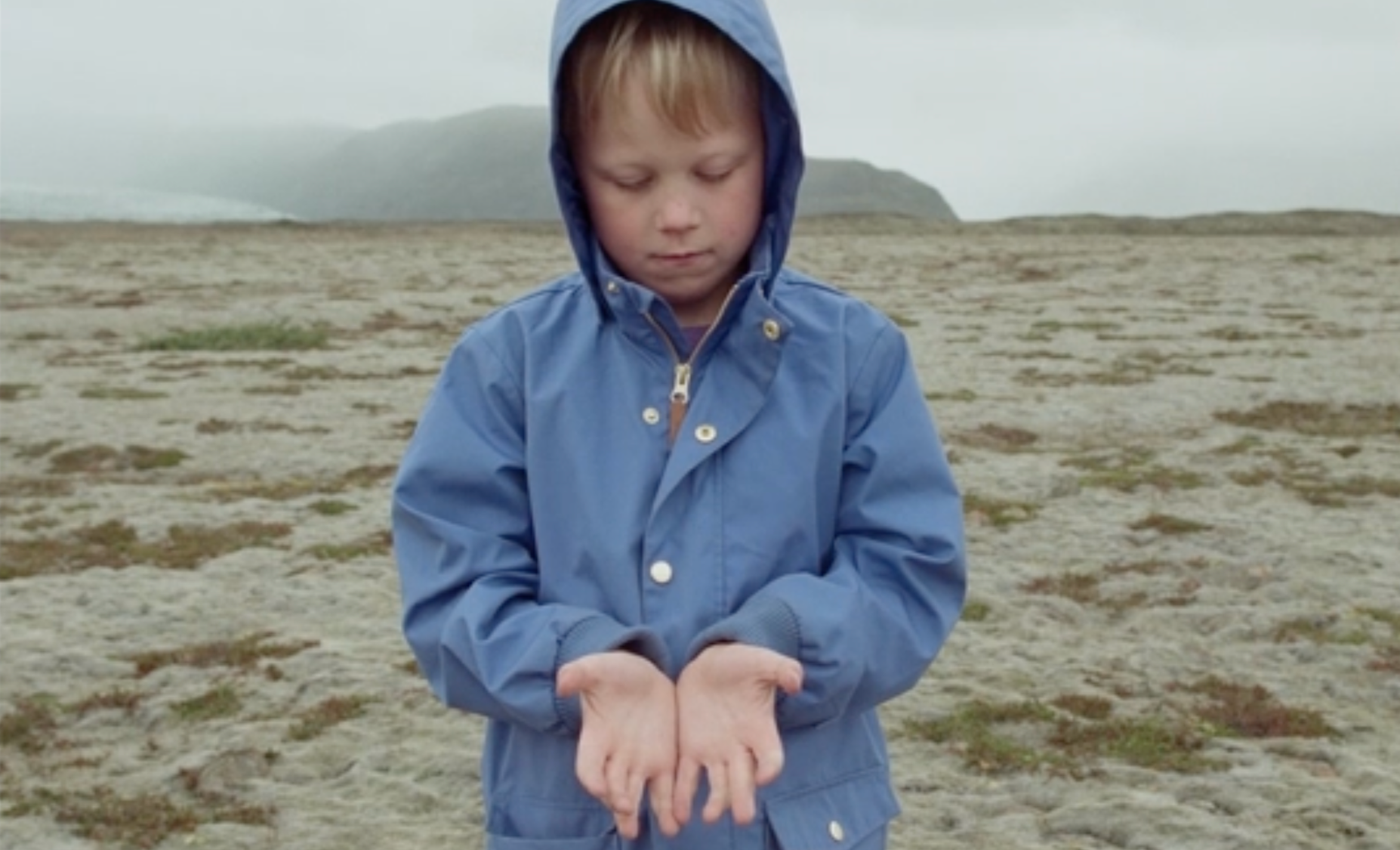
Dear c.,
The black cat died today. It's a very warm day, the warmest of the year, good for resting in the damp, cold earth. I'm writing you this letter from a ship. It's sinking, and I'm the only person still on board. I know it's not dangerous, because I'm on dry land. It's sinking into the earth, growing roots. Maybe it's just a dream in which to lose myself.
PLENTY OF FEELING IN THE SEA
If love is a building on fire (as David Byrne convinced me), then what is a ship sunk on dry land? And what about a building without a roof?
The first scene of the film (Ástin sem eftir er / The Love That Remains, 2025, Hlynur Pálmason) — because this is what I'm writing to you about — in which a roof is torn off a building, is a wonderful prelude to the process of decomposition: a process of transformation, gradual and imperceptible, almost invisible, which becomes evident only in retrospect.
We have a family (label). The mother (label), Anna, is an artist (label), the father (label), Maggi, is a fisherman (label), children, grandparents, critters. Each has their assigned role in this archi-familiar structure, the nuclear family. We see them together — eating, going on hikes, joking, picking blueberries, watching films — everything is so normal, so banal, so natural. Just like the banality of cruelty slips past our protective barriers and strikes right in the soft tissue of our feelings, so too the banality of the love that remains — the love that has always been and will always be — manages to slip through and stir strings of emotions untouched for sentimental centuries.
And if we accept "love is a building on fire" as a given, then a building without a roof is love on the day you tell yourself: "I hope someone I hate forgot to close the gate, I hope Maggi forgot to close the gate, so I have a reason to kill him." It's the day when the roof is lifted off by the playful demiurge who removes one of the two (!) from the play and leaves the other to rearrange the furniture.
Time is not chronological; it isn't clear from the start that this is a family undergoing restructuring. In the beginning Anna's father suggests Maggi could buy her a horse, if he wants to "keep" her, and we learn of Anna's "single" status much later on from the guy in Reykjavík who helps her with photo editing while making backhand passes at her. The details arrive crumb by crumb, along the way; the characters tell us who they are without us being able to assemble a complete portrait, without us being able to read the fine print on the labels of their relationships. Each one reveals themselves in small details — manners, gestures, conversations. I felt like a creature in symbiosis with each of them, in turn — a microorganism with a backstage pass to their lives.
MASCULINE FEMININE
At some point, on unfamiliar ground, I went a little down the path of dichotomy: as if there were only two characters in the film, the feminine character (the mother and also Panda, the grandmother, the goose, the daughter, the target-doll) and the masculine character (the father and also the grandfather, the colleagues on the fishing boat, the obnoxious curator, the target-doll).
SHE is so beautiful — a beauty that comes from a calm acceptance of herself, a kind of aura belonging to someone who does what she wants without worrying about what others do or think, but also from her acceptance of the everyday (dishes, laundry, washing the dog), which through its very absoluteness seems even to bring her pleasure, makes her serene, stoic, light.
HE is sad, small, wordless — the infantilized man who wants but doesn't know how to ask, who doesn't have the words, who has only blunt arrows of manipulation that never come close to the target, attempts to make himself useful, to take a stance, when it's too late or superfluous. The martyred rooster is a proof of love, the lying promise people make when they say "I'll change" - a desperate attempt to return to "how things used to be", without doing any work. It's easier for him to pretend nothing happened than to confront anything; he prefers to drift, pulled and pushed.
SHE cuts him short, not out of malice, but out of an acute sincerity or a cruel sense of practicality: "go home," "it's simpler when you're not around," "we’ve tried before, I don’t want to confuse the kids."
The skirt scene during the hike, when he gets lost in its waves, exposes his sensitivity more than anything else — a sensitivity he perhaps masks through an unquestioned, automatic association with Bjartur (Halldór Laxness, Independent People), the manhero with a solid but inflexible ethic, incapable of update, for whom feelings are weakness (though not even this is said out loud).
The rooster's death is a kind of kill the Bjartur ego, but, in a moment of magic realism, it returns as a monstrous rooster that devours (so I imagined) Maggi, restoring the order of the drift in which he indulges.
SHE is the shoreline of his thoughts, which get lost at sea.
There is a generational chasm between those who grew up with Bjartur as a hero and resonated with him, and those who questioned his modus operandi — the way his obsession with independence came before everything, at the cost of alienating his entire family.
Maggi's colleague, who says that "the young generation can't do anything, they're all weaklings, you can't tell them anything", also offers the antidote to Bjartur's inability to be fully human:
"Maggi, do you want my advice?"
"No."
"I'll give it to you anyway, plus a fish fillet. Always put yourself last. Take care of your family and be kind to your children and your wife. (...) There's no such thing as 'you' and 'your time' — that's just a phenomenon invented by the internet."
A MONOLOGUE OF DEATH
I'd like to take a small detour to visit the obnoxious curator. As with any colonized peoples, the Icelanders' animosity toward their colonizers is palpable, and it translates into the absurd portrait of this bland, but irritating Swede (who could just as easily be Danish or Norwegian). His character captures the essence of everything most unpleasant about continental Scandinavians — their almost religious small talk, their arrogance hidden beneath an unshakable feeling of superiority that they pretend not to have. The obnoxious curator is the essence of the white male who has power over someone else (I'm buying this piece of land, I'm stealing this egg). Whether his plane crashed or not doesn't even matter; the viewer has experienced catharsis.
JOAN OF ARC
This little film-within-a-film, sprinkled throughout, is Chronos — an unconventional keeper of time. The target-doll is the toy doll of all the characters, in front of whom there is no need to hide. Suddenly, she wears an armor, and here again I lost myself in the thicket of analogies: for Anna, the armor is protection regarding what she lets in, a boundary (no, we tried, now go home). For Maggi, it shields his shame, keeps it hidden inside, blocks the transfer of feelings to others — and perhaps even to himself.
Anna does the work of care: she sprinkles salt around so no one slips, puts the helmet on her head, gives her a peck on the cheek. To Maggi, the doll appears personified; he gives her a glass of water, but the water leaks out of her, through the holes left by the arrows. Nothing can satisfy her, he cannot satisfy her. "What are you? Are you a woman? Are you beautiful?"
Everything slowly unravels, and everything continues just the same. The transformation of the parents' relationship doesn't trouble anyone except Maggi who, without the anchor of family, floats adrift. We see him literally floating, in an immersion suit (a kind of life-raft suit), after he throws himself into the water to catch the fishing boat Jona (the biblical Jonah, in the belly of the whale), which is on its way to shore, where one of the children had an accident.
It's not clear how much time passes, but day has turned into night. The boat doesn't appear. Swallowed by the whale.
"Fucking Jona!"
Maggi the fearful, the coward, Maggi adrift at sea.
“YOU AND YOUR TIME” IS A PHENOMENON INVENTED BY THE INTERNET
With the expertise of a (de)constructing engineer, but the haste of a delivery boy, I say that The Love That Remains is a quilt film, an artistic technique possibly born from an "I work with what I have" which, instead of destroying everything, becomes a creative/creating force. Pálmason filmed many scenes alone, over time. I got lost in it, I stopped to admire and unpick every detail, I slipped from one rabbit hole into another, and I liked it there, beneath the cold and damp earth. I left its thicket with the feeling that exposing fear is the only way to fight it, and that self-knowledge is not a luxury but a human condition — finding your way to your soft core, so that you are not merely form.
It's a film you "read" however you want, however you can — it's not fixist, it doesn't accept only one mode of reception. It gives you too much, it gives you all the time; you take what you want, what you can. It's a film within a film, next to another film from within the film, many stories within one, a mini-narrative neatly packaged to satisfy even the eternal seeker of narrative thread, poetic essays in visual form that give the whole the shape of a cloud above an Icelandic landscape: unforgiving, full of an intense, alien beauty. Even the soundtrack is a film in itself — it created in me an image-feeling: a cake decomposing in slow motion, on a table, outside, in the rain.
The Love That Remains is not a mathematical equation. It is the love that has always been there. It is not the remainder of all the love minus the love that has gone. It is the heavy portrait, told with the lightness of cinematic language, of a crumb of the present, with traces of people.
L.
May 3rd 2026 Samsø
written for cinesseur